

Anne London
Moment of Clarity
Acrylic on linen canvas
Anne London is an American wildlife artist whose powerful charcoal drawings explore the beauty, character and vulnerability of some of the world’s most iconic animals. Based near New Orleans, she is particularly known for her large-scale portraits of African wildlife, created with an immediacy and intimacy that reflects decades spent observing animals in the wild.
London’s distinctive monochrome works are often executed in charcoal, a medium she uses to capture both fine detail and dramatic contrasts of light, shadow and texture. Elephants, lions, rhinos, primates and other threatened species frequently appear in her work, but her portraits go beyond straightforward representation. By focusing closely on faces, gestures and expressions, she seeks to present animals as individuals and encourage viewers to recognise their intelligence, emotional complexity and intrinsic value.
Africa has been a profound influence on London’s life and career. She has travelled extensively across the continent, spending time in the field and developing close connections with conservationists, researchers and local communities. These experiences have shaped both her artistic practice and her commitment to protecting wildlife.
Conservation is central to London’s work. She founded Arts for Animals, an initiative using art and creative education to encourage young people, particularly those living close to wildlife and protected areas, to engage with conservation. Through exhibitions, educational programmes and partnerships, she has used her art to support greater understanding of the challenges facing wild species and their habitats.
London’s work has been exhibited and collected internationally, earning recognition for both its technical accomplishment and its conservation message. At its heart is a belief in the ability of art to create empathy. By bringing viewers face-to-face with individual animals, her striking portraits invite a deeper connection with wildlife and reinforce the urgency of protecting it for future generations.
Understanding Nature
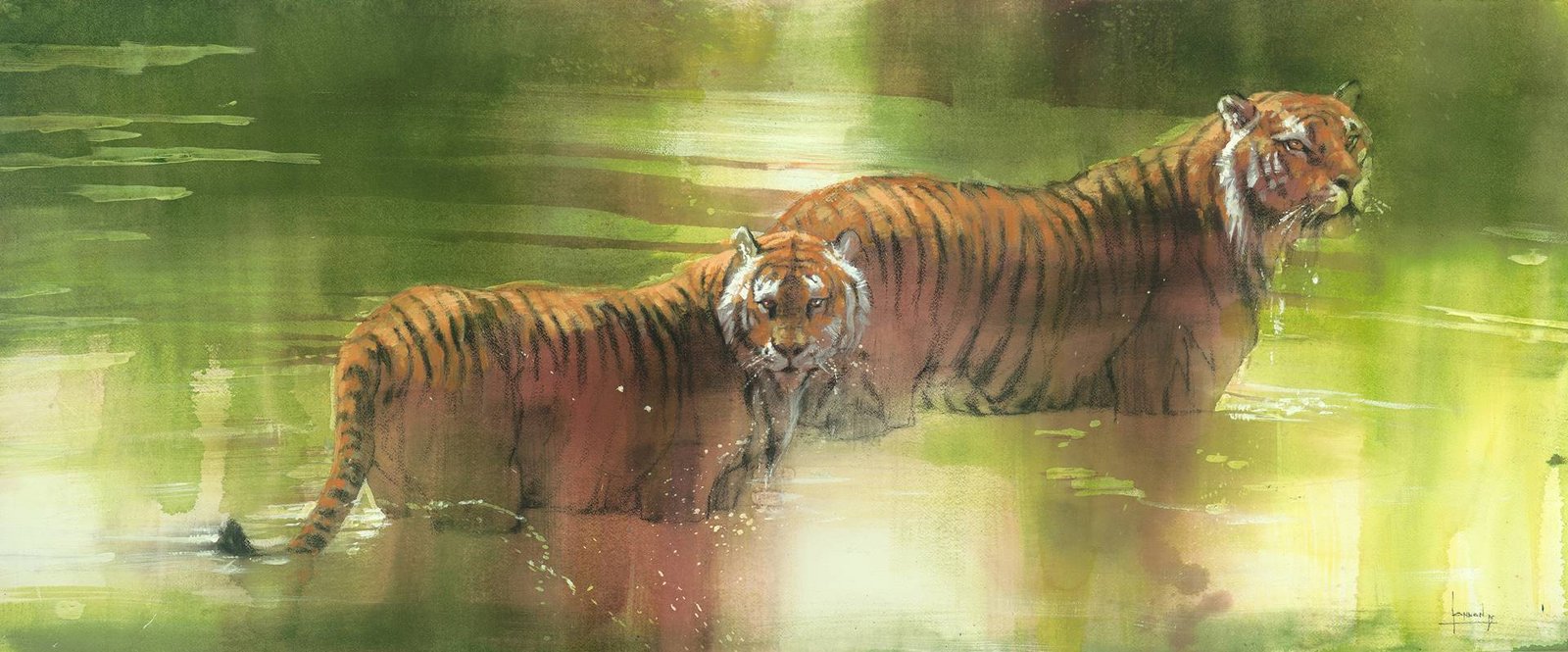
Bengal tigers require vast connected landscapes rich in prey. Rising seas threaten the Sundarbans mangrove forest, while elsewhere forests are becoming increasingly fragmented by development. As tiger habitat shrinks, encounters with people become more common, making long-term coexistence one of conservation’s greatest challenges.
Modern conservation begins with understanding the natural world. Camera traps, GPS tracking collars, genomics, bioacoustic monitoring and drones reveal how wildlife uses the landscape, how species respond to environmental change and which landscapes are most important for their survival.
In Bhutan, a landscape believed to support 30% of the world’s wild cat species and one of the few places where tigers and snow leopards are known to occur within the same connected ecosystem, a new three-year study, supported by Explorers Against Extinction, will create the first comprehensive photographic inventory of mammals, identify wildlife corridors and understand how Himalayan mammals respond to a changing climate.