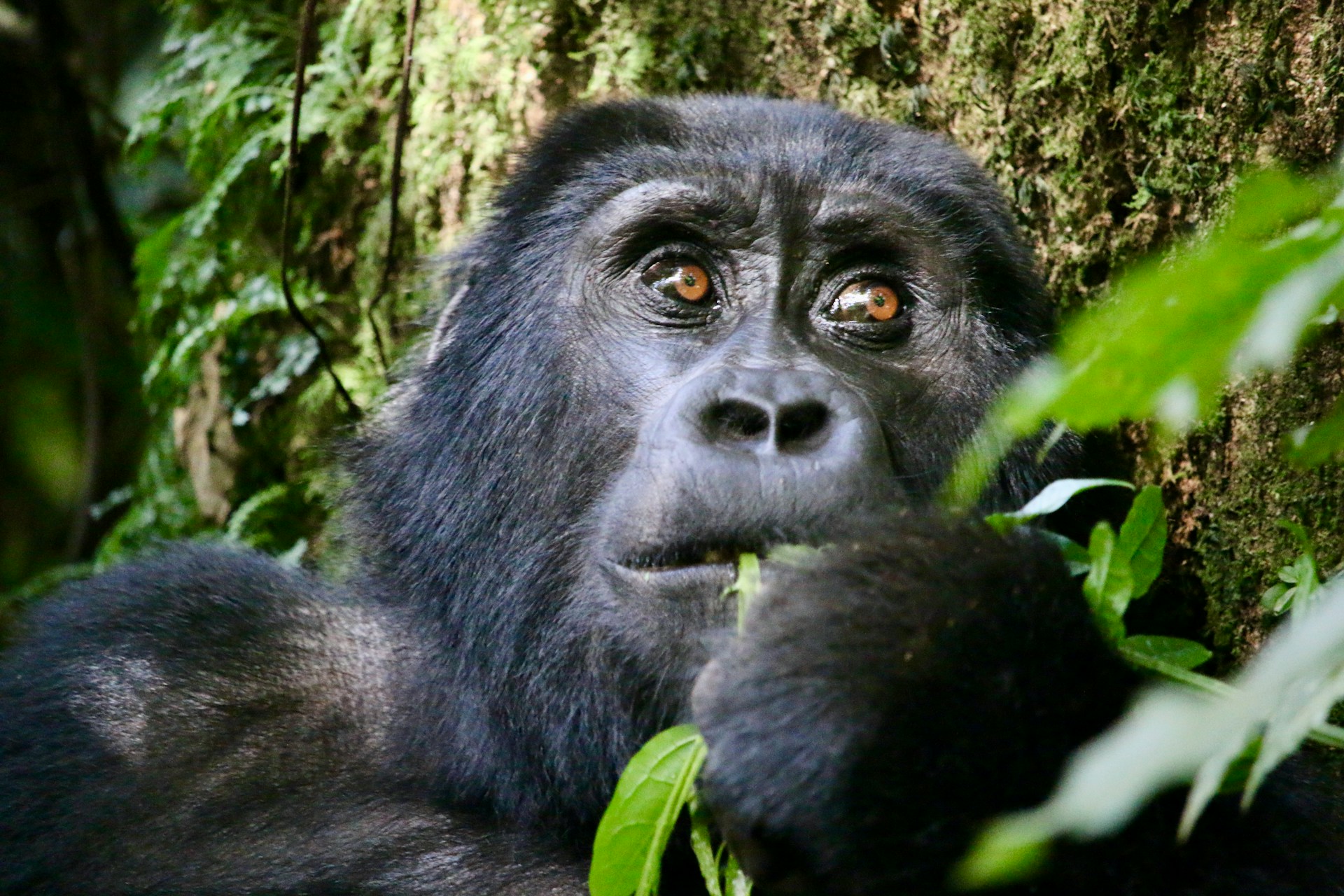
Mountain gorillas are associated with many wonders that are worthy discovering. Often visited by tourists on gorilla safaris, these great apes are some of the world’s rarest with their population estimated to be about 1050 individuals. From their close resemblance to humans with whom they share 98% of the DNA to their well-structured social life, we explore the amazing gorilla behavior to guide you into the life of these gentle giants in the wild.
Mountain gorillas are the only thriving gorilla subspecies
Apart from humans, mountain gorillas are the only great apes whose population is increasing. Other gorilla subspecies are critically endangered but the steady increase in the number of mountain gorillas over the past few decades, encouraged the IUCN to reclassify them from critically endangered to endangered in 2018. There are currently about 1,063 mountain gorilla individuals in the wild compared to about 250 which were existing in the early 1980s. These great apes are protected in two separate habitats: Bwindi Impenetrable Forest and the Virunga Massif. This success is a result of relentless conservation efforts from both local and international wildlife authorities as well as non-government conservation organizations like the Dian Fossey Fund which is trying to protect mountain gorillas in Uganda, Rwanda and DR Congo.
Gorillas Learn from one Another
Although they don’t possess the speaking abilities of humans to communicate to each other, gorillas are still able to learn from one another. Gorillas use basic forms like imitation which include copying particular body motions to cope up with different situations. This has been evident in a way how gorillas learn that snares are dangerous even before being caught in one. They learn this by watching the way their experienced group members react when they are either trapped by a snare or trying to avoid one.
Gorillas Can be Emotional too
Like humans, gorillas have emotions and they feel distress and grief when they face unfortunate situations. At some moment, gorillas were observed trying to mourn their dead colleague by walking around the dead body several times and later covering it with vegetation. Unlike humans, gorillas don’t produce tears but they use vocalizations instead which is the same as crying in humans. Gorillas only produce tears when they are lubricating their eyes.
Groups of Solitary Males are Common among Mountain Gorillas
Though gorillas are known to be very social in nature, mountain gorillas have an exception especially when it comes to the male gorillas. As each gorilla family is led by one dominant male, a silverback, many males don’t thrive in the group. At juvenile stage, many male gorillas leave their native groups and become solitary until they are able to form their own groups by attracting females to join them from other groups. Groups of solitary male gorillas are common and one male will leave after succeeding to form his own group with a few females.
Gorillas are Vegetarians but not 100%!
Vegetation provides the main diet for gorillas and they consume about 200 different species of plants within their habitat throughout the year. However, gorillas have also been observed feeding on other organisms like invertebrates and most strangely they were once observed eating their dead baby! This is because gorillas may not want to leave their dead babies to be eaten by other animals like cats anticipating that they may start hunting them to eat more gorillas after tasting their meat.
Silverback Gorillas Play a Big Role in Raising Infants
Adult male gorillas play a big role in nurturing infants as they spend caring and socializing with them trying to teach them several skills. Amazingly, silverbacks struggle to know which infant is theirs and this may be the reason why they decide to spend most of their time with the older infants. On several occasions, silverbacks are seen babysitting infants while their mothers are foraging.
Gorillas are Less Social than Chimpanzees
Although gorillas also live a kind of social life, they score pretty low on the social scare compared to their counterparts, the chimps. Gorillas are much more socially reserved unlike chimps which embrace, hold hands and even kiss while interacting with one another. In their social set, gorillas are also selective in how they associate with each other including in the way they sit and play while in their groups. Researchers have also studied proximity patterns among gorillas to discover reconciliation between individuals. Surprisingly, gorillas were found to love sitting near their former opponents after a fight in order to re-establish their broken relationship.
Gorillas build new nests to sleep in every night!
Mountain gorillas don’t just sleep in the open, they set up nests to sleep in wherever the night finds them. It may sound as hard work to be done daily but they make it as simple as possible using just around 5 minutes to set each nest. They basically use vegetation like leaves, tree branches and parts of bushes which form layers of beddings in their circular nests. Most of the nests are built on the ground though some gorillas may choose to set up theirs at an elevated area.
Gorillas don’t do much in a day
Gorillas don’t get involved in too many activities during day. They spend their typical day while foraging, traveling and resting. Movement is also highly limited with only about one mile moved per day by these gentle giants. 95% of the gorillas’ day is made up of resting, foraging and travelling with the other part of the day spent while participating in social activities like playing and grooming.
Brave blackbacks can take on leading silverbacks for dominance
Although it is well established that a gorilla family is led by the dominant silverback, sometimes a brave blackback within the group may challenge the leading silverback to takeover leadership. This was evidenced in Volcanoes National Park in Rwanda when silverback Titus challenged his predecessor and dominant silverback Beetsme at the age of 17 and he successfully took over the leadership of the group leaving Beetsme as his assistant.