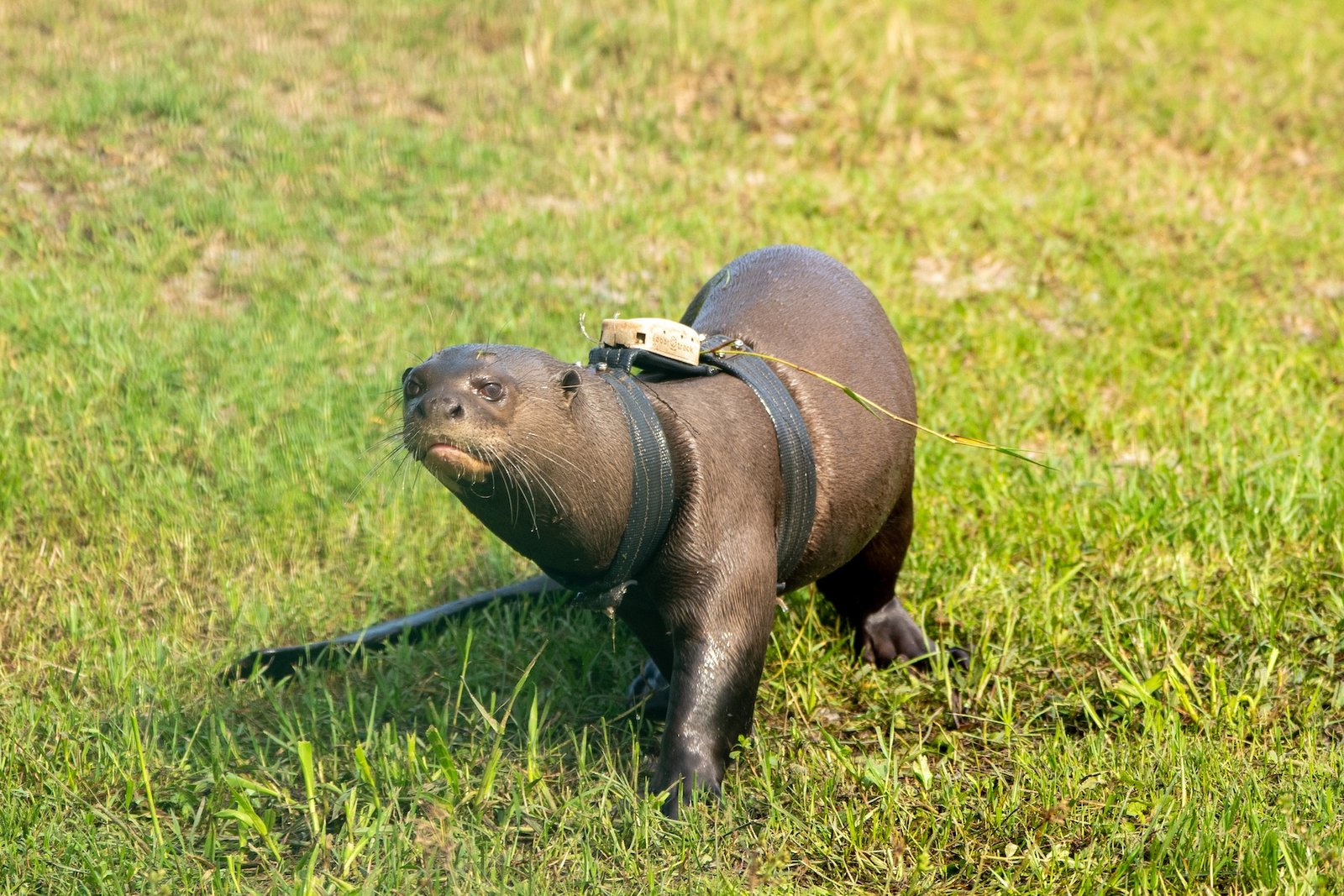
The giant otter (Pteronura brasiliensis) is one of South America’s most charismatic yet endangered species. Known as the “river wolf,” it can grow up to 1.8 m (almost 6 ft) long, weigh as much as 34 kg (75 lb), and lives in tight-knit family groups – a hallmark of its social nature.
Once Widespread Across South America
Historically, giant otters were found from the Orinoco basin in Venezuela, across the Amazon basin, and down into northern Argentina, Uruguay, and Paraguay. By the 1980s, however, they had disappeared from much of their southern range, including Argentina and Uruguay.
The main causes of this decline included:
- Commercial hunting for pelts (especially in the 1950s–70s)
- Deforestation and wetland destruction
- Pollution and mining
- Human disturbance and overfishing
Today, the last remaining strongholds are in Brazil, home to the largest population, and Peru and Bolivia, with smaller populations still existing in Guyana, Suriname, and French Guiana.
In Argentina, the last known family groups were sighted in 1986. A rare, lone individual reappeared in 2021, likely having travelled from the Paraguayan Pantanal.
A Historic Reintroduction in Iberá Wetlands
Last month, a family of giant otters was released into Iberá National Park – a vast protected wetland in Corrientes province, northeastern Argentina.
The rewilding effort, led by Rewilding Argentina and supported by Projeto Ariranhas and international partners, included:
- A breeding pair, Coco and Nima, translocated from European zoos
- Their offspring, Pirú and Kyra, born in captivity
This release marks the first return of a mammalian species declared extinct in Argentina, and the first reintroduction of giant otters to an area from which they had disappeared.
Why It Matters
Giant otters are the top aquatic predator in their habitats, feeding almost exclusively on fish. Their presence plays a pivotal role in maintaining healthy freshwater ecosystems.
The initiative began in 2017, with years of planning and logistical preparation. The otters’ release into the two million-acre Iberá wetlands is a milestone for species restoration in South America.
Supporting Giant Otters in Brazil
Explorers Against Extinction is proud to back the work of Projeto Ariranhas in Brazil. In 2024, we helped to fund research to map migration corridors and identify recolonisation areas in the Pantanal, where genetic diversity is historically low.
Highlights from 2025 include:
- 18 new otters named, including five cubs born in 2024, underscoring the value of each individual.
- The start of the 2025 field season in Porto Jofre, which included training in biological sampling, behavioural observation, habitat mapping, and community outreach.
This long-term monitoring has so far identified 89 individuals in the Porto Jofre region and documented the birth of 48 cubs since 2019.
Did You Know?
- Each giant otter has a unique throat pattern used by researchers to identify individuals.
- Family groups, called holts, usually include 3–8 members.
- A family of otters can consume up to 3 kg of fish per day.
A Symbol of Hope
The release of an otter family into Lake Paraná in Iberá – combined with ongoing work in the Pantanal – shows what’s possible when science, dedication, and collaboration unite.
Protecting rivers and wetlands does not just safeguard one species. It protects entire ecosystems and the people who depend on them.
📷 Projeto Ariranhas / Lucinda Di Martino