

Gazellah Bruder
Octopus Garden, 2025;
Mixed Media on Paper
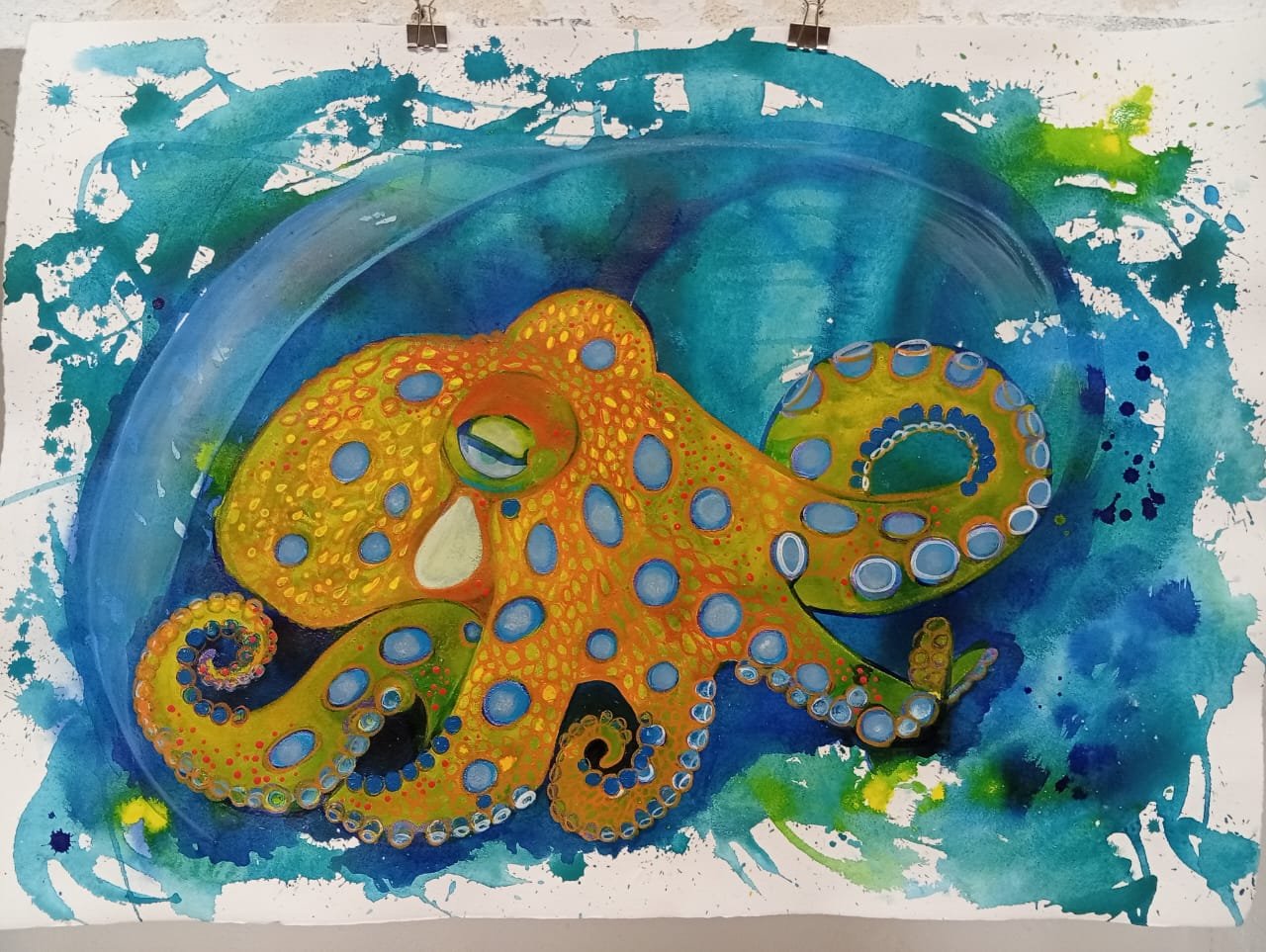
Gazellah Bruder is one of Papua New Guinea’s most prominent contemporary artists, known for work that explores identity, gender, social justice and humanity’s relationship with the natural world. Born in Port Moresby in 1977, she is of Tolai and Mekeo ancestry and studied Fine Art, Art and Design, and Visual Anthropology at the University of Papua New Guinea.
Working across painting, printmaking, sculpture, textiles and illustration, Bruder has developed a distinctive visual language that often places the female form at its centre. Her work examines the experiences of women in Papua New Guinea, addressing inequality and gender-based violence while celebrating female strength, resilience and identity. She sees art as a powerful means of storytelling and of opening conversations around difficult social issues.
Environmental concerns have become an increasingly important part of Bruder’s practice, particularly ocean pollution, deforestation and the wider human impact on the natural world. Her recent work explores ideas of colonisation, identity and restitution alongside the urgent need to protect Pacific oceans and marine life.
Bruder has exhibited extensively in Papua New Guinea and internationally, with more than 50 exhibitions, and her work is represented in the collection of the National Gallery of Australia.
Climate Change in Papua New Guinea
Papua New Guinea is one of the world’s most biologically and culturally diverse countries, but its geography and dependence on natural resources make it particularly vulnerable to climate change. Around 90% of Papua New Guineans depend to some degree on the country’s natural resources for their daily subsistence, meaning changes to rainfall, temperature and ecosystems have a very direct impact on people’s lives.
For low-lying islands and coastal communities, sea-level rise is one of the most immediate threats. Higher tides and coastal erosion are reducing the amount of habitable and cultivable land, while saltwater intrusion contaminates freshwater supplies and damages food gardens. Some island communities are already facing displacement. In Bougainville’s remote atolls, for example, rising seas and exceptionally high tides are destroying crops and disrupting traditional fishing grounds.
Further inland, the challenge is different. Rainfall is becoming less predictable, with communities exposed to both prolonged drought and heavier rainfall. Floods and landslides can destroy crops, roads and other infrastructure, while drought and frost in the Highlands threaten subsistence agriculture. Rising temperatures can also reduce crop yields and encourage pests and diseases, increasing pressure on food security.
Papua New Guinea’s extraordinary biodiversity is also at risk. Warmer seas, marine heatwaves and ocean acidification threaten coral reefs and coastal fisheries, while changing temperatures and rainfall can alter habitats on land. Species adapted to particular climatic conditions, especially those in mountain ecosystems, may be forced into progressively smaller areas as temperatures rise.
Climate change therefore reaches far beyond the environment. It threatens food and water security, livelihoods, health, infrastructure and communities, while increasing competition for already limited resources. For a country that contributes relatively little to global greenhouse-gas emissions, Papua New Guinea is experiencing a disproportionately heavy share of the consequences.