

Tichaona Ncube
Rhythms of Community, 2026;
Watercolour and Pen
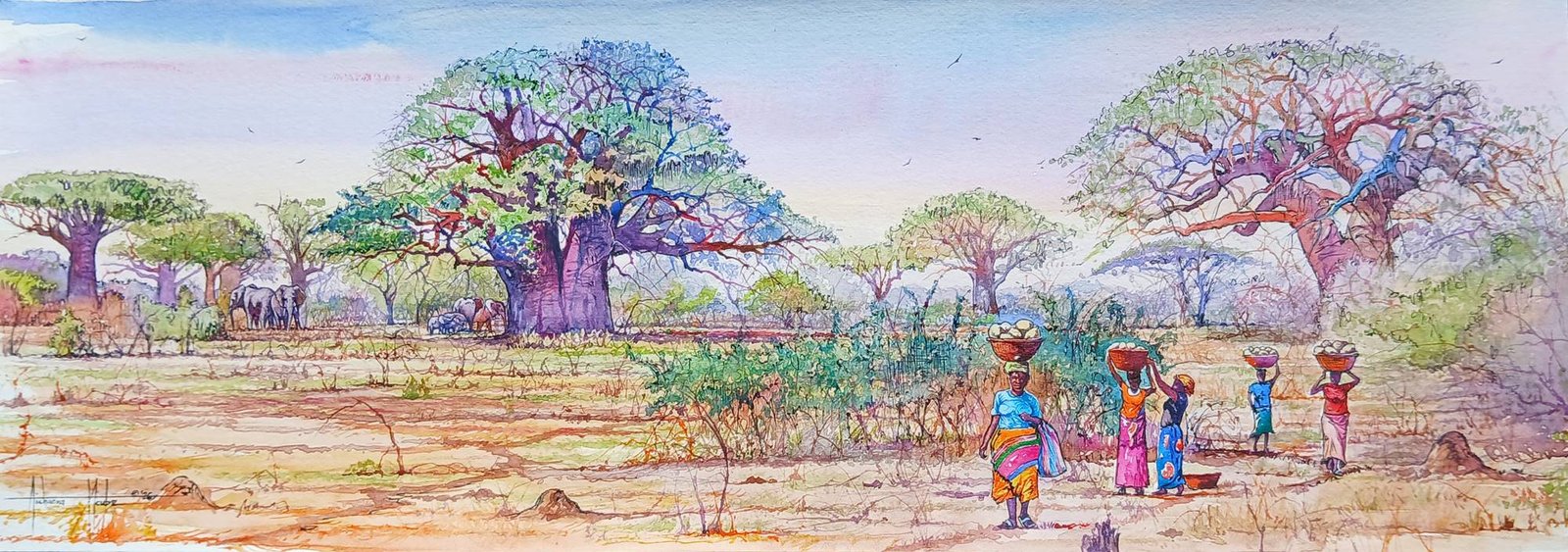
Tichaona ‘Tich’ Ncube is a Zimbabwean wildlife and portrait artist based in Victoria Falls, whose close connection with the natural world stretches back to his childhood. Born in 1986, he grew up in rural Tsholotsho, near Hwange National Park, where he spent much of his time herding cattle. He began drawing the animals and landscapes around him, particularly cattle and kudu encountered while out in the bush.
After moving to Victoria Falls for his secondary education, Ncube began pursuing art professionally in 2002. Largely self-taught, he was encouraged and mentored by Zimbabwean artists Sanele Dhlomo and the late Jimmy James Nkomo. Today he works across a wide variety of media, including oil, acrylic, watercolour, pastel and pencil, producing portraits and landscapes as well as wildlife paintings.
Wildlife remains at the heart of his practice. Ncube is particularly drawn to elephants, lions, leopards, cheetahs and painted dogs, using his work not simply to celebrate their beauty but to communicate the importance of protecting them. He sees art as a powerful and accessible way of encouraging people to think about conservation and humanity’s responsibility towards the natural world.
His work has been exhibited in Zimbabwe and internationally, including through the David Shepherd Wildlife Foundation’s Wildlife Artist of the Year, where his painting Vigilance was selected for the 2023 exhibition. Ncube has also been a longstanding contributor to Explorers Against Extinction, donating work to Sketch for Survival on several occasions and participating in its On the Brink collection.
Climate Change in Zimbabwe
Zimbabwe is highly vulnerable to climate change because so much of the country’s economy, food production and rural life depends on rainfall and natural resources. Temperatures are rising, rainfall has become increasingly variable, and droughts and extreme weather are placing growing pressure on both people and wildlife. The World Bank reports that the frequency of drought increased from around one in every ten growing seasons during 1902–1979 to approximately one in four between 1980 and 2011.
Agriculture is particularly exposed. Most farming in Zimbabwe is rain-fed, meaning that delayed rains, prolonged dry spells and drought can quickly translate into failed harvests, livestock losses and food insecurity. Climate projections suggest that severe droughts will become more likely, particularly in western Zimbabwe, while periods of extreme heat and consecutive dry days are expected to increase.
Water scarcity is another major concern. Reduced and less predictable rainfall, combined with higher temperatures and evaporation, affects rivers, reservoirs and groundwater. This can intensify competition for water between communities, agriculture and wildlife, especially during the dry season.
At the same time, climate change is increasing the risks associated with extreme rainfall, floods and tropical storms. Zimbabwe has experienced destructive cyclones originating in the Indian Ocean, while intense rainfall can cause flooding, erosion and damage to homes, crops and infrastructure.
For Zimbabwe’s remarkable wildlife, climate change adds another layer of pressure to habitats already affected by human activity. Drought can reduce water and grazing, alter vegetation and concentrate animals around remaining water sources. As wildlife travels further in search of food and water, it may increasingly move beyond protected areas and into farmland and settlements, raising the potential for human-wildlife conflict.
Climate change in Zimbabwe is therefore not simply an environmental issue. It is closely connected to food, water, livelihoods, biodiversity and the ability of communities and wildlife to coexist in an increasingly unpredictable landscape.