

Nasim Hantehzadeh
The Light Contest, 2026;
Crayon on Paper
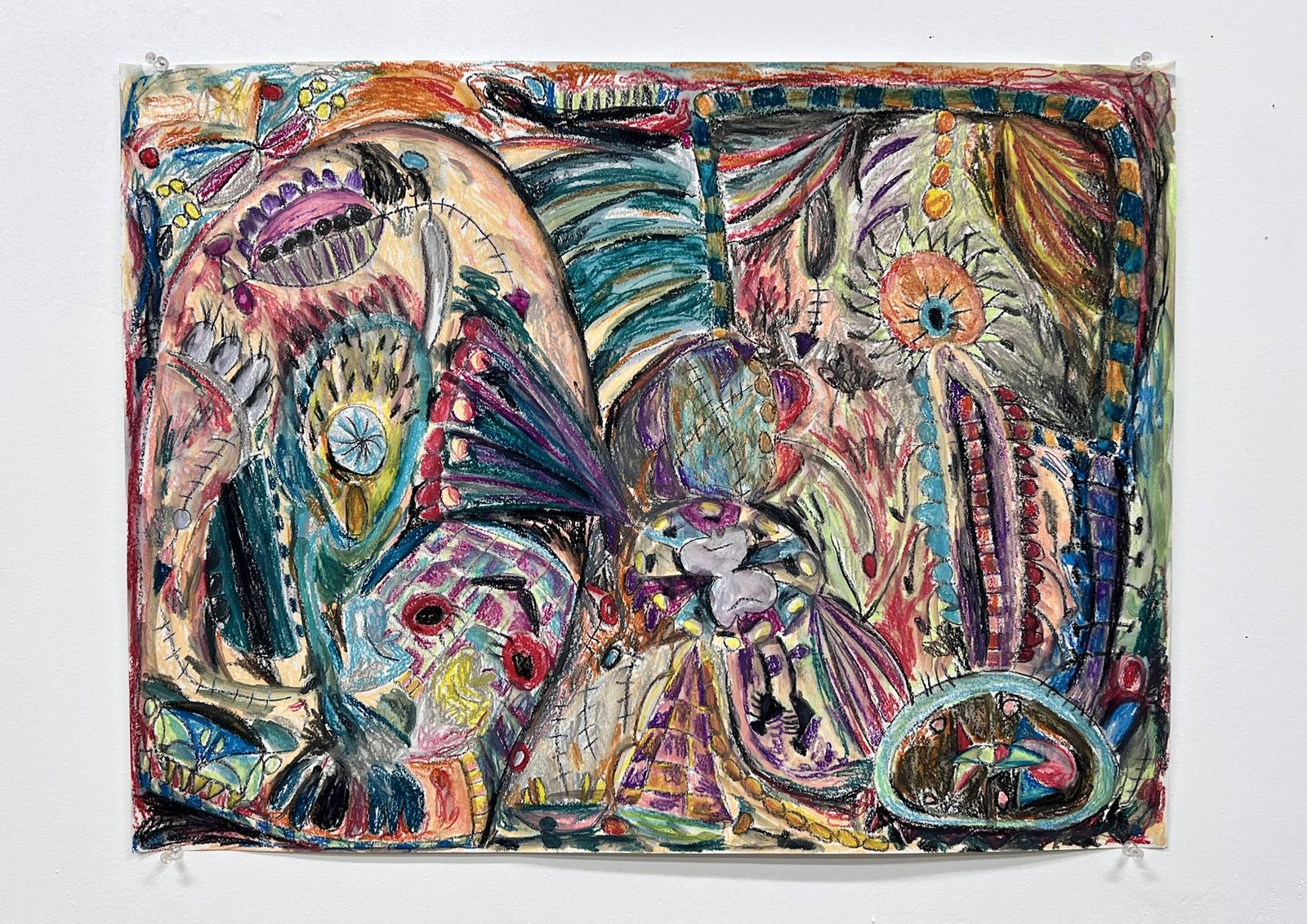
Nasim Hantehzadeh is an Iranian-American artist whose bold, highly distinctive paintings and drawings explore identity, sexuality, cultural memory and the experience of existing between different worlds. Born in Stillwater, Oklahoma in 1988 and raised in Tehran, Hantehzadeh returned to the United States as a young adult and now lives and works in Los Angeles. They studied at the University of Tehran Center for Art and Architecture before completing a BFA at the School of the Art Institute of Chicago and an MFA at UCLA in 2018.
Working primarily with oil, pastel and graphite on canvas and paper, Hantehzadeh creates energetic compositions in which figures, symbols and abstract forms merge and transform. Their visual language draws from a remarkably broad range of sources, including ancient Persian carpets and Islamic architecture, Paleolithic cave painting, pre-Islamic art and Indigenous art from Mexico. Rather than presenting the human body conventionally, figures are often fragmented, distorted or reshaped, creating fluid forms that resist straightforward definitions of gender and identity.
Personal experience is an important foundation for Hantehzadeh’s work. Growing up in Iran before returning to the country of their birth created a powerful sense of cultural “in-betweenness”, while memories, family, language and changing perceptions of identity all feed into their practice.
Hantehzadeh has exhibited internationally, including at Frieze London, Art Basel Miami Beach and the Museu de Arte de São Paulo, and held their first European solo exhibition, Ray of Light, at Pippy Houldsworth Gallery in London in 2022.
Climate Change in Iran
Iran is already a naturally dry country, but climate change is intensifying pressures on water, landscapes, wildlife and people. Temperatures have risen while precipitation has shown a declining trend, increasing evaporation and worsening water scarcity. The UN Development Programme reports that Iran has already experienced an average temperature rise of around 0.7°C, with further warming expected.
Perhaps the most visible impact is water stress. Drought, reduced rainfall and rising temperatures are placing additional pressure on rivers, groundwater and wetlands already affected by intensive water use. Important ecosystems such as Lake Urmia and the Hamoun wetlands have suffered severe decline. Climate change is not the sole cause, water extraction, dam construction and agricultural demand are also major factors ,but a hotter, drier climate makes their recovery increasingly difficult.
Agriculture is particularly vulnerable. Much of Iran is arid or semi-arid, and farming depends heavily on reliable water supplies. Higher temperatures and prolonged drought can reduce crop yields, degrade soils and increase the demand for irrigation, with consequences for rural livelihoods and food security. At the same time, desertification, land degradation and increasingly severe sand and dust storms affect both ecosystems and human health.
Climate change does not simply mean less rain. Iran is also vulnerable to more extreme weather, including intense rainfall and damaging floods. Climate projections indicate continued warming, while future changes in precipitation are more complex and vary between regions and climate scenarios.
For Iran’s wildlife, the combination of rising temperatures, shrinking wetlands, drought and habitat degradation creates additional pressure on already threatened species. As water and productive land become scarcer, wildlife and people are also increasingly forced to share limited resources, potentially increasing human-wildlife conflict.