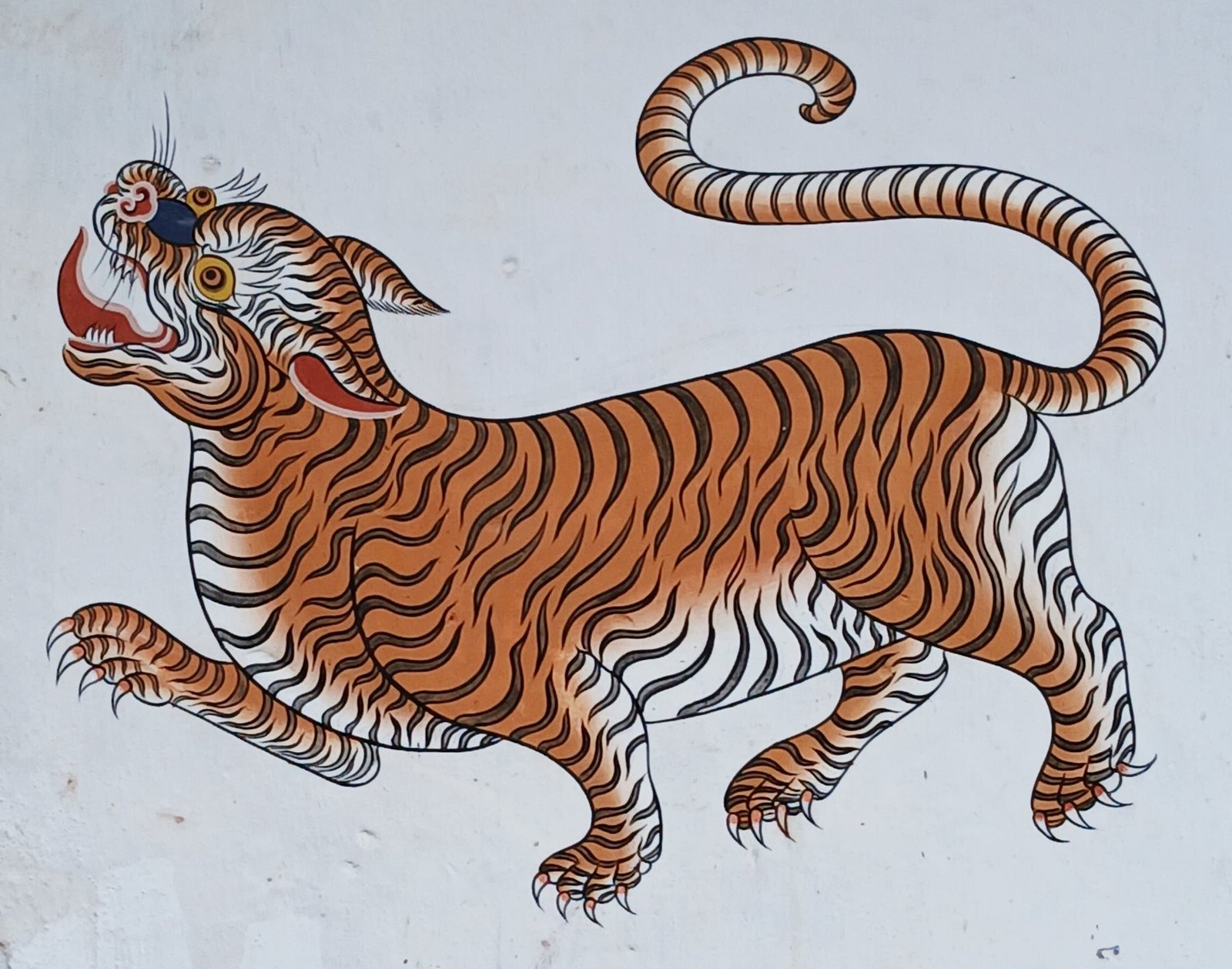
High in the mountains of Bhutan, where forests cover its steep valleys and ridges, one of the world’s most elusive predators still roams. The Bengal tiger, more often associated with the sweltering jungles of India or the mangrove swamps of the Sundarbans, also survives here at altitudes that would surprise even seasoned conservationists. And standing at the forefront of efforts to understand and protect these big cats is Dr. Tshering Tempa, Bhutan’s leading tiger biologist and a pioneer of homegrown conservation science.
On my recent visit to Bhutan I met up with Dr. Tempa and spent a fascinating afternoon chatting about his work and ambitions for the future.

From student to scientist
Tshering Tempa’s journey into wildlife science began with forestry, studying in India before moving to the United States to specialise in wildlife biology. At the University of Montana he completed both his master’s degree and PhD, focusing his doctoral research on the ecology of Bengal tigers in Bhutan’s rugged, high-altitude habitats. That choice of topic was unusual. While much tiger research had concentrated on the great lowland reserves of India and Nepal, Bhutan offered a fresh challenge: steep terrain, sparse prey at higher elevations, and limited access. It was the perfect place to explore how adaptable tigers really are.
Building Bhutan’s capacity
For years, Bhutan relied heavily on visiting experts for wildlife research. Dr. Tempa has helped change that. After returning home, he became a driving force behind efforts to build Bhutan’s own scientific capacity. He worked with the Bhutan Tiger Centre and government partners to introduce systematic camera-trap surveys, train young rangers in field science, and establish long-term research programmes. Today, Bhutan can monitor its tiger population, analyse data, and design conservation strategies largely with its own expertise. That shift, from dependency to self-reliance, is one of his most important achievements.
Tigers at the top of the world
One of the discoveries that put Bhutan on the conservation map was the presence of tigers at extraordinary elevations. Camera traps set by Dr. Tempa and his colleagues recorded tigers at over 4,000 metres above sea level. These images challenged long-held assumptions that tigers were restricted to lowland forests and swamps. In Bhutan, the big cats roam from tropical foothills just above the Indian border to alpine meadows where yaks graze. This wide range suggests that tigers may be more resilient to environmental change than previously thought, provided their corridors remain intact.
The national tiger survey
Perhaps the most important milestone of his career so far was leading Bhutan’s comprehensive national tiger survey in 2021-22. Using hundreds of camera traps spread across the country, the team built a clearer picture of how many tigers lived within Bhutan’s borders and where they were distributed. This survey gave Bhutan a accurate population estimate and provided a foundation for future monitoring. It also proved that the country could carry out research of global significance on its own terms. The survey showed a population increase of 27% from the previous census in 2014, with 131 confirmed tigers.
Breaking new ground with collaring
In 2018, Dr. Tempa and his team achieved another Bhutanese first: successfully radio-collaring a wild tiger. The female, later named Tendrel Zangmo, became a symbol of scientific progress. Her GPS collar provided hourly updates on her movements, revealing how tigers use corridors, where they hunt, and how they interact with people and livestock. Collaring is logistically complex and potentially risky for both animal and scientist. That Bhutanese researchers were able to plan and execute the operation independently spoke volumes about how far the country’s conservation science had advanced.
Beyond numbers: health and survival
Counting tigers is only part of the picture. Dr. Tempa has also been involved in investigating threats less visible than poachers or habitat loss. One example was the detection of canine distemper virus, a disease known to devastate big cat populations elsewhere. Studying the risk of disease in Bhutan’s small and scattered tiger population is vital, since even a single outbreak could undo years of progress. His research also covers predator-prey relationships. By studying prey availability and ecological dynamics, he is helping to ensure that tigers have the wild food sources they need, reducing the likelihood of conflict with herders.
Expanding frontiers
Bhutan continues to surprise scientists with new tiger records. In recent years, camera traps captured images of tigers in districts where they had never been documented before. Each discovery adds to the sense that Bhutan may serve as a stronghold for the species, providing safe passage between India and the Tibetan Plateau. For Dr. Tempa, these records are not just exciting finds but essential data. Each photograph helps identify individuals, track their movements, and build a national repository of tiger images that informs conservation strategies.
Challenges ahead
Protecting tigers in Bhutan is not straightforward. The country’s dramatic terrain makes fieldwork arduous and costly. Human-wildlife conflict is an ever-present issue, particularly where tigers attack livestock. And small populations remain vulnerable to disease and genetic isolation. Despite these challenges, Bhutan holds a unique advantage: its constitutional commitment to protect at least 60% of its land under forest cover, and its philosophy of Gross National Happiness, which balances development with environmental stewardship. Dr. Tempa’s work dovetails with these national priorities, blending cutting-edge science with Bhutanese values of respect for nature.
A vision for the future
Looking ahead, Bhutan plans to repeat its national tiger survey to measure progress. Continued radio-collaring, genetic sampling, and disease monitoring will deepen understanding of tiger ecology. There are challenges ahead, such as the degradation of upland pasture impacting the behaviour of these large carnivores as their prey moves lower in search of food.
Community-based conservation, education, and conflict-mitigation schemes will be essential to ensure people and tigers can coexist. Dr. Tempa’s vision is clear: a Bhutan where tigers are not a rarity but a symbol of thriving landscapes. By training young scientists, he ensures that the next generation can carry the work forward.
Legacy in the making
At its heart, the story of Dr. Tshering Tempa is about more than one scientist. It is about a country taking ownership of its natural heritage and proving that even small nations can make a global impact. Through his leadership, Bhutan has shown that rigorous science and local stewardship can go hand in hand. In a world where tiger numbers are under constant pressure, Bhutan offers a glimmer of hope. And at the centre of that story is a quiet, determined scientist who chose to dedicate his career to the survival of one of the planet’s most charismatic and most endangered animals.