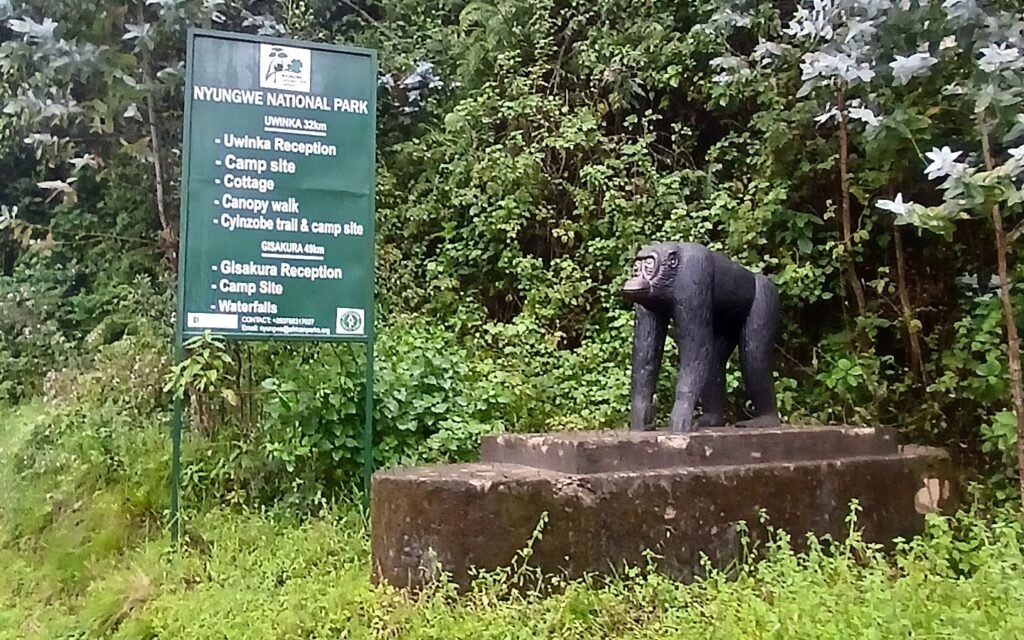
There’s a certain kind of quiet you only notice when you’ve left everything else behind. I found it in Nyungwe National Park, deep in Rwanda’s southwest, where the roads narrow, the air cools, and the forest begins to close in around you like the living thing it is. We arrived in the late afternoon, having driven across the heart of this beautiful, and spotlessly clean, country. We’d slowly climbed through tea plantations until the National Park started, announced by a large statue of a chimpanzee. Our base for the next couple of days was Munazi Lodge, tucked discreetly into the edge of the rainforest. It wasn’t long before I realized that this wasn’t just a place to stay, it was part of the experience itself.
Nyungwe National Park stretches across Rwanda’s southwestern hills as one of Africa’s oldest rainforests, rich in biodiversity and atmosphere. Now run jointly by the Rwandan Government and the NGO African Parks, it is home to chimpanzees, colobus monkeys, and over 300 bird species, it offers a rare sense of immersion in untouched nature. Mist drifts through dense canopies, and narrow trails wind through ancient trees, making every visit feel quietly adventurous. Beyond wildlife, Nyungwe is a place of stillness, where the forest sets the pace and rewards patience. Whether trekking for primates or crossing its canopy walkway, the experience feels intimate, grounding, and deeply connected to the natural world.
Settling In: Munazi Lodge and the Charm of Inkomo
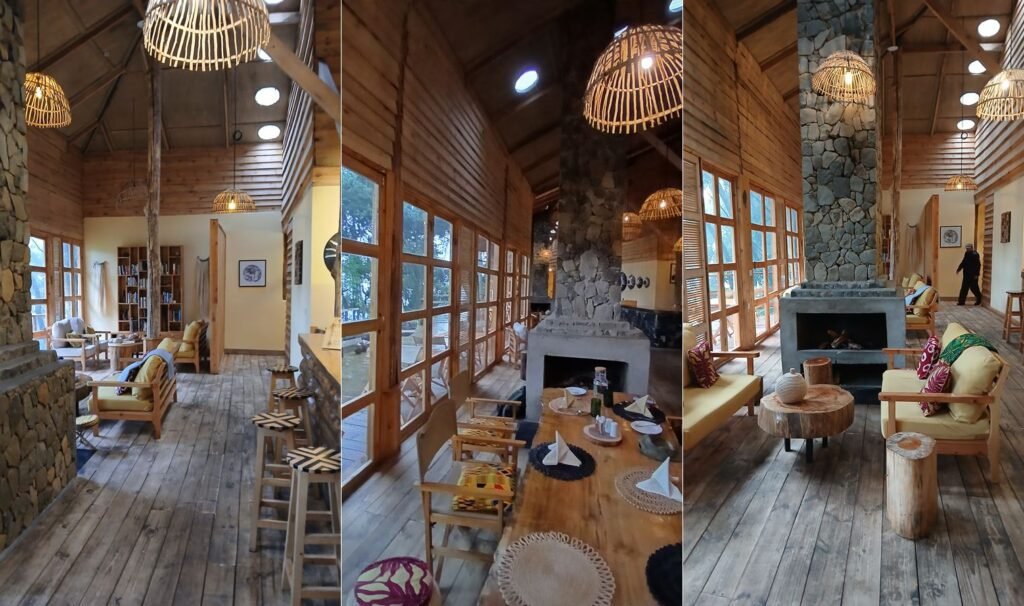
Our chalet was called Inkomo, meaning Colobus Monkey in the local dialect. It sat slightly apart from the others, surrounded by thick greenery that seemed to hum with life. There’s something deeply grounding about staying somewhere that feels both remote and intentional, where the design doesn’t compete with nature but quietly complements it. Inside, Inkomo struck a balance between rustic and refined, with a warm wooden interior that held onto the cool mountain air, large windows that framed the forest like a painting, and a small terrace where mornings began with birdsong. The bed was set high up on a mezzanine level, giving a warm, intimate feel to a otherwise large space. Hot water bottles were a welcome surprise as you climbed into the large bed.
Evenings at Munazi Lodge were relaxed and atmospheric. A large terrace with firepit offered wonderful views down over the valley. Inside, the chimneys in the lounge were double sided meaning that all guests had their own log fire to sit in front of. Dinner was unhurried, often shared with other travellers swapping stories of muddy boots and unexpected wildlife encounters. The staff carried a quiet pride of the lodge, and conversations drifted easily between English, French, and Kinyarwanda. It felt less like checking into a hotel and more like being welcomed into a place that knew exactly why you had come.
The 6AM Start: Into the Forest for Chimpanzees
The alarm went off at 5:15 am, though I was already awake. There’s a kind of anticipation that doesn’t let you sleep deeply, the quiet excitement of knowing you’re about to do something unique in your life. We reached Uwinka Visitor Centre just before 6 am. The mist was still hanging low, wrapping itself around the trees and softening the edges of everything. Our guide greeted us with the calm efficiency of someone who has done this many times before but still exudes enthusiasm for the job.
The drive that followed was part of the adventure. For over an hour, we bumped along muddy tracks in a 4×4, slipping and sliding along, gripping handles as the vehicle tilted and corrected itself. It wasn’t comfortable, but it was thrilling in a quiet, shared way, everyone aware that the journey itself was a kind of initiation. Eventually, the road ended and from there, we walked. The forest quickly swallowed us. The path was narrow, the ground soft, and the air thick with moisture. Every now and then, our guide would pause, listening and interpreting. It felt like he was using a language we didn’t yet understand. After about an hour, he found the spotters. They had already located the chimpanzees, on the move after a night high in the canopy in nests they had built to be used only once.
Forty Minutes with the Wild
The first sound I noticed was movement around us, a rustling that didn’t come from the breeze. Suddenly, they were there. A family of chimpanzees, moving through the trees with a kind of effortless confidence. Some paused to look at us, others carried on feeding, completely uninterested in our presence. For forty minutes, we followed them. Not too close, not intrusive, but close enough to feel that we were sharing their live with them for those few precious minutes.
There’s a strange recognition when you watch chimpanzees, not just because they resemble us, but because their expressions, curiosity, irritation, playfulness, feel familiar in a way that’s difficult to explain. A young chimp clung to its mother, peeking out at us with wide eyes, while another swung between branches with surprising speed, disappearing and reappearing like a shadow. The locals believe that chimpanzees are humans who thousands of years ago decided to move back to the forests and have adapted to life there. They will not hurt them and have learnt which plants and mushrooms are edible by watching what the chimps eat.
Then, just as suddenly as they had appeared, they were gone. They moved through the thick forest at a pace we couldn’t match, our way blocked by undergrowth, fallen trees and small streams. It was as if they had decided they’d had enough of the morning’s entertainment of human watching and had decided to move on. The forest closed in again, and the silence returned. It didn’t feel like something that had ended, more like something we had briefly been allowed into.
Birdsong and the Slow Return
The walk back felt different, lighter somehow. Less about searching and more about noticing. Nyungwe is known for its birdlife, part of the Albertine Rift, one of Africa’s richest biodiversity zones, and even for someone like me, who can’t name half of what I see, it was impossible not to be drawn in. Bright flashes of colour cut through the green, and calls echoed from unseen branches, sunbirds, hornbills and many other species enthusiastically pointed out by our guide and spotters. Every few steps, something new revealed itself if you were paying attention. It’s the kind of place that rewards patience rather than urgency.
The Canopy Walk: Seeing the Forest Differently
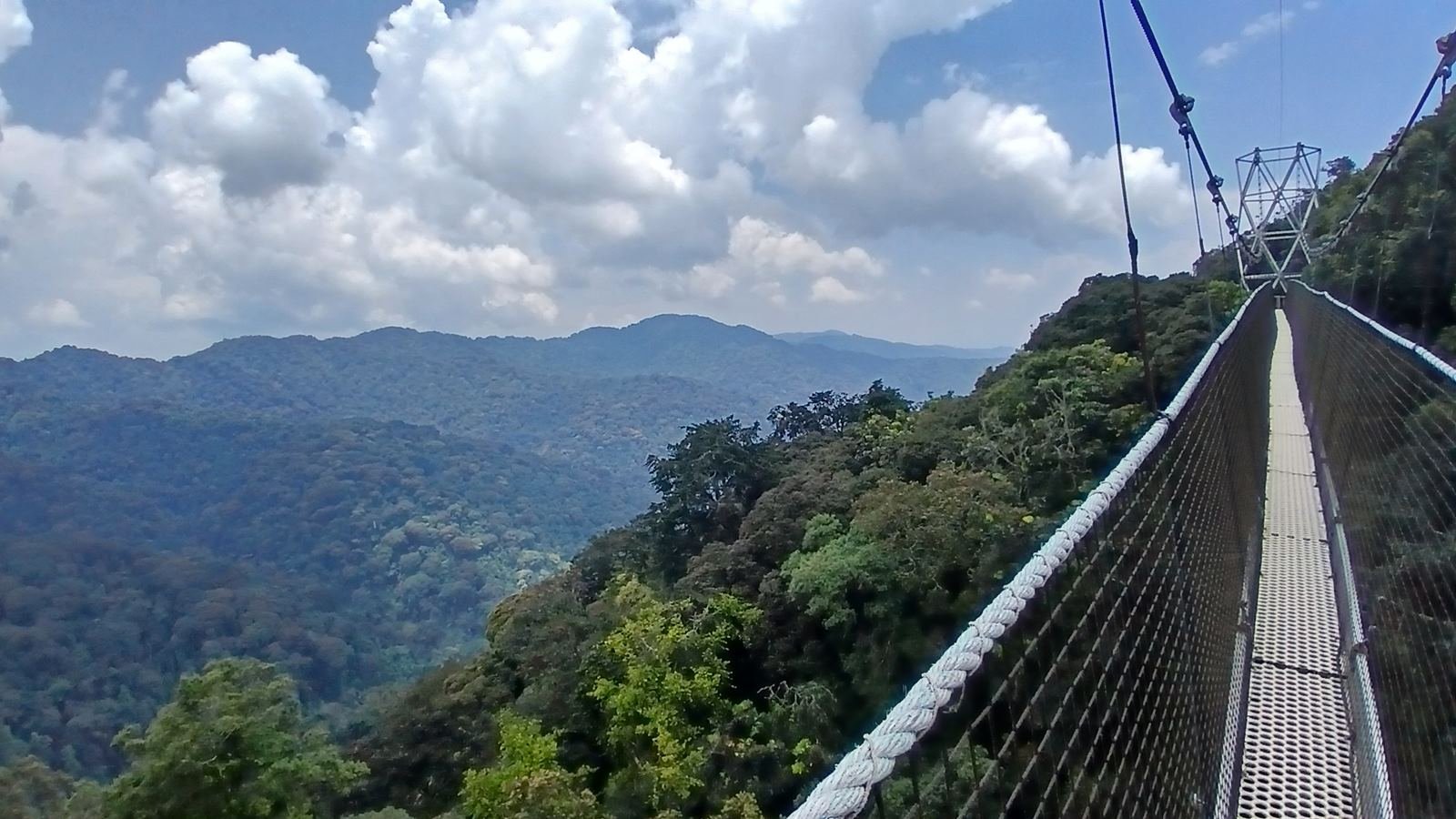
Back at Uwinka Visitor Centre, we could have easily called it a day; wet, muddy and tired. But Nyungwe has a way of drawing you further in, it’s beauty and peacefulness keeping you there. That’s how we found ourselves stepping onto the canopy walkway later that morning. Suspended high above the forest floor, the bridge swayed gently beneath our feet. At first, there’s a moment of hesitation, you feel the height, the movement, the openness, but then something shifts and you start to see the forest differently. From above, the dense canopy becomes a textured landscape. Layers of green stretch endlessly away down the valley, broken only by the occasional rise or dip. Sunlight filters through in patches, creating a mosaic of light and shadow and birds fly beneath you.
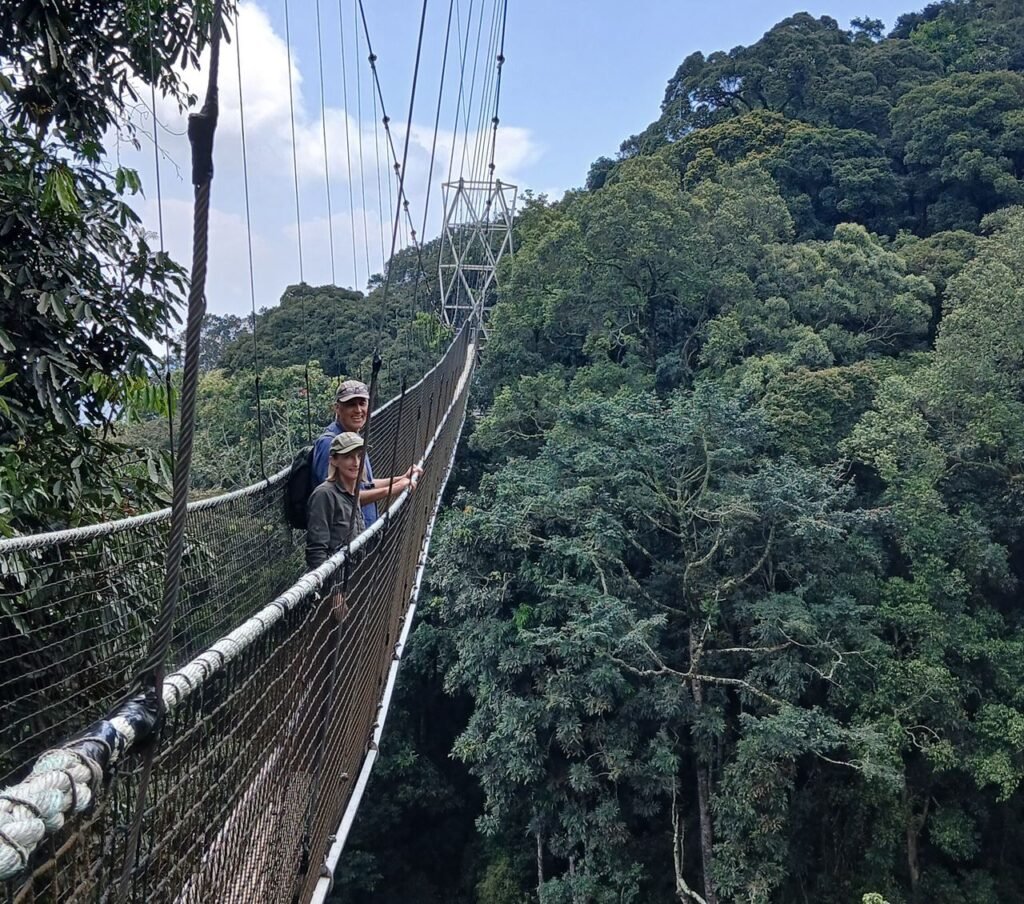
We were joined by a community ranger whose knowledge added a completely different dimension to the experience. He didn’t just point things out, he told stories. Plants weren’t just plants, they had uses, histories, meanings. Trees carried local legends, some protective, others cautionary, and even the silence had context. It turned what could have been a simple walk into something much richer, a reminder that landscapes are not just physical spaces but cultural ones too.
Reflections on Nyungwe
What stayed with me most about Nyungwe National Park wasn’t just the chimpanzees, though they were unforgettable. It was the feeling of being somewhere that still operates on its own terms. There’s no rush here, no sense that the forest is performing for you. You have to meet it where it is, through early mornings, muddy paths, and moments of waiting, and when you do, it offers something genuine in return.
A Few Practical Notes (From Experience)
If you’re considering making the trip, a few things I learned along the way: start early, because the 6 am meet at Uwinka Visitor Centre isn’t optional, it’s essential; prepare for mud, as the 4×4 drive and trek can be challenging, especially after rain; bring layers, since mornings are cool but the humidity builds quickly; bring a hat and sunglasses as you will be pushing in places through some fairly thick foliage; and listen to your guide, because they’re not just there for safety, they shape the entire experience.
Was Munazi Lodge Worth It?
Absolutely. Munazi Lodge isn’t about luxury in the traditional sense. It’s about location, atmosphere, and a sense of connection to the place you’ve come to explore. Staying in Inkomo, as with any of the chalets, added something personal to the trip, a quiet space to process everything we had seen, heard, and felt. If I’m honest, it’s the kind of place I still think about unexpectedly, not because of any single standout moment, but because of how everything fit together so well and how relaxing it was. A special place to recharge mentally as well as physically.
Leaving the Forest
On our final morning, I stepped out onto the terrace of Inkomo with a cup of coffee and watched the mist lift slowly off the trees. There’s always a moment, just before you leave somewhere like this, when you realize you’ve adjusted to it more than you expected. The sounds, the pace, even the uncertainty of what you might see all start to feel normal, and then you go. But Nyungwe doesn’t really leave you. It lingers in the quiet, in the memory of movement overhead, in the feeling of standing on a swaying bridge looking out over something vast and alive. It’s not the kind of place you just visit; it’s the kind of place you take with you.
Explore Rwanda with Explorers Against Extinction’s tailormade travel programme – all bookings support on-the-ground conservation at no additional cost to you.